
Vacuum Handling Solutions for Industrial Automation
Keeping automated production lines fast, precise, and reliable.
Why vacuum becomes the critical point in automation?
Unlike robots or PLCs, vacuum is in direct contact with the product, whose properties constantly change.Surface porosity, shape, weight, and cycle speed make vacuum either a stability factor or a cause of line stoppages.
To secure production, vacuum management must address four key challenges:
Variable surfaces and leakage (Grip Instability)
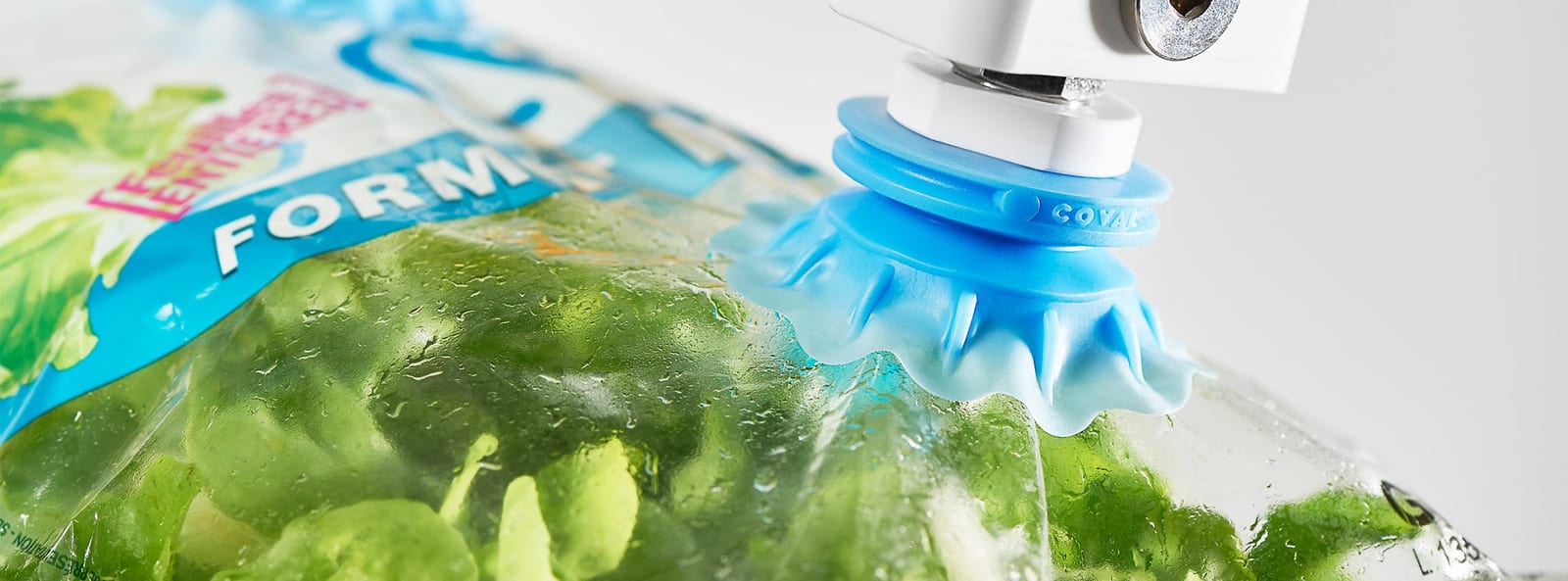
Handling products with varying surfaces—such as porous cardboard, flexible plastics, or FlowPack packaging—can make gripping unstable.
Suction cups and vacuum pumps designed to manage leakage and porous materials, ensuring stable grip without performance loss.
Increasing cycle speeds (cycle time)
As production speeds increase, vacuum system response time becomes critical.
Compact, close-to-process vacuum solutions reduce evacuation volume and deliver fast, repeatable gripping at high speeds.
Energy pressure (costs and environment)
Uncontrolled compressed air consumption is a hidden cost and a source of waste.
ASC and ASR technologies cut compressed air consumption by up to 90% while maintaining consistent holding force.
Lack of process visibility (diagnostics)
Traditional vacuum systems are often “black boxes” until a failure occurs. The lack of visibility into vacuum behavior prevents preventive maintenance.
IO-Link and fieldbus communication provide real-time monitoring, diagnostics, and control of vacuum performance.
At COVAL, we develop Vacuum Manager solutions to support industrial automation objectives such as productivity, profitability, quality, safety, and energy efficiency.
Being a Vacuum Manager means going beyond the role of a traditional vacuum component supplier.It is about understanding applications, managing constraints, and delivering controlled vacuum performance under real production conditions.
application-driven innovation
close-to-process service and support
shared technical expertise with our customers
Discover the COVAL Vacuum Manager approach
What a Vacuum Manager changes on a production line?
A Vacuum Manager does not optimize a single function.It stabilizes the entire handling process and protects production against variability over time.
Concrete operational impact
Fewer unplanned stops through controlled and repeatable grip
Lower scrap rates by maintaining stable handling under changing conditions
Reduced energy consumption by supplying only the air required
Simplified diagnostics and maintenance through real-time monitoring
Performance is not only achieved at commissioning.It is monitored, adjusted, and supported throughout the full product lifecycle.
Improve line performance with Vacuum Management
Define the required behavior before selecting a product
The critical question is not which product to choose.It is what behavior the vacuum system must deliver under real operating conditions.
Key selection criteria include:
Surface porosity and expected leakage rate
Required cycle time and response speed
Compressed air quality and stability
Integration, monitoring, and diagnostic requirements
A properly designed vacuum handling solution maintains predictable performance even as conditions vary.
From component choice to operational reliability
Vacuum handling directly affects:
Operator confidence and safety
Treating vacuum as a simple component rather than a controlled subsystem is a strategic mistake that increases risk over time.
COVAL’s vacuum handling solutions are engineered to secure automation, not complicate it, by translating application constraints into controlled, repeatable performance.
Need more information about our vacuum gripping components
Explore Vacuum Manager solutions
An industrial vacuum applied to suction cups is an efficient method for handling objects and materials.This technique was developed to meet industrial automation needs, with applications in parts assembly, finishing, testing, transfer, packaging, etc.
COVAL is committed to making your vacuum handling system energy-efficient. Our goal is to optimize the overall performance of your equipment by operating on the following three principles:
Analyzing the system to identify the potential for savings.
Selecting the most appropriate solution.
Including COVAL energy-saving technologies, such as ASR and ASC, in our products
Stay up to date with COVAL
New solutions, technical insights, and field feedback from our Vacuum Manager experts.
MPXS Series Controlled Communicating Micro Vacuum Pumps
CVGC Carbon Vacuum Gripper Series
CMS M Series Multi-stage Mini Vacuum Pump
资料来源:企业官网公司简介(复核日期:2026-10-07)。